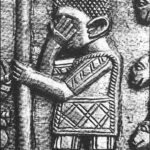
My choice for our Christmas image in the Poustinia is an everyday African scene. A woman ‘backing’ her baby and her partner carrying a heavy load on his head. It was painted by the Ugandan artist, Francis Sekitoleko, to depict the Holy Family’s flight into Egypt. It was made during the dangerous years of Idi Amins’s repressive dictatorship, when so many men, women and children had to flee for their lives. Sadly, the fleeing of repressed peoples in their millions is still an everyday scene in many parts of the world. In fact, refugees escaping war, genocide and the effects of climate change is on a scale never experienced before.
The United Nations Refugee Agency reported in June this year that 117.3 million people had been forced to flee their homes as the result of persecution, conflict, violence and human rights violations. In stark terms and easier to grasp., the agency estimates that one in every seventy people of the world’s population are forced to flee their homes sometime during their lives.
The familiar Christmas story being depicted in cheerful Nativity plays across the country is more harshly relevant in today’s world than ever before. The account of the Holy Family escaping the murderous threats of King Herod, is recorded in Matthew’s gospel chapter 2 verses 13 – 23. Having heard from the magi about the birth of a potential messiah, the king became paranoid that this child might threaten his grip on power.
As all parents know, the one place you wish to be when nursing a new-born, is home. Mary gave birth while travelling, then shortly after she and Joseph were forced to flee their country with their precious bundle. That this was how Jesus entered human society demonstrates God’s extraordinary humility and identification with the worst examples of human suffering.
‘Thanks be to God for his extraordinary gift’
David Hawkins Christmas 2025